
Windscreen Repair & Damage
What Is Actually Built Into Your Windscreen?
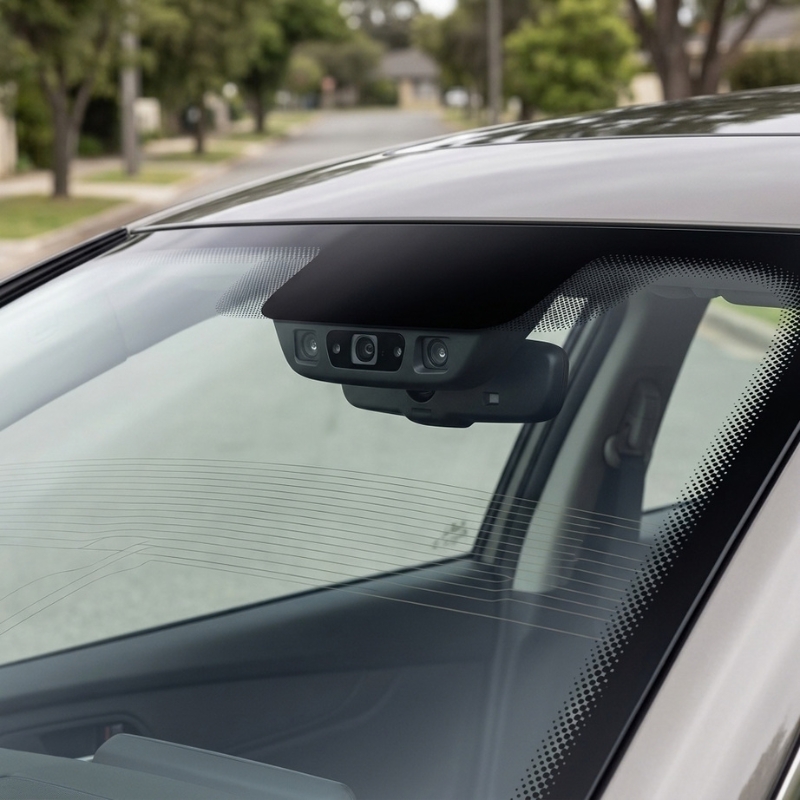
A modern windscreen is a laminated sandwich of two glass layers with a plastic interlayer, and it can also carry a rain sensor, a forward-facing camera, a heating element, an acoustic damping layer and a printed ceramic band. Each of those makes the glass a specific part for your car rather than a generic sheet.
Most people picture a windscreen as a window, but it is closer to a component with several systems built into it. A modern screen can carry a rain sensor, a camera, a heating element, an acoustic layer and a printed black band, and each of those turns the glass into a specific part for your car rather than a generic one. At Windscreen Replacers we fit auto glass across Sydney, and the make-up of the screen is what decides which part your car takes. This article walks through each element, what it does, and how you can tell whether your car has it.
The part nobody thinks about: the layer in the middle
The most important thing in your windscreen is the layer you cannot see. A windscreen is laminated, which means two sheets of glass bonded to a thin plastic interlayer in the middle. That interlayer is why a windscreen cracks and holds together rather than shattering into fragments the way a side window does, since a side window is toughened glass with no interlayer to bind it. The safety consequence is the whole point: the interlayer keeps the glass in one piece in front of the people in the car, which is why the Australian Design Rules treat the windscreen as a structural part of the body rather than a pane sitting in a frame. It also means damage often stays shallow, trapped in the outer layer, which is why a windscreen chip repair can often restore the glass rather than needing a full replacement.
The rain sensor behind the mirror
A rain sensor windscreen has a small optical sensor pressed against the inside of the glass behind the mirror, and it is what lets the wipers run themselves. You can usually see it: a small block, often with a clear gel pad, mounted to the glass inside the mirror housing. It works by shining infrared light into the screen and measuring how much bounces back, so water sitting on the outside scatters the light and changes the reading, and the wipers respond.
That has real consequences for a replacement. The glass has to have the correct mounting bracket moulded into it for your car, the gel pad has to be reseated cleanly against the new screen, and if it is not, the wipers can behave oddly afterwards. An air bubble trapped under the pad is the usual reason wipers run on a dry screen, because the sensor reads the bubble as water.
Why rain sensing wipers go wrong after a replacement
If the automatic wipers misbehave after a new screen, there are three usual causes: the gel pad was not fully bedded down, a bubble is trapped under it, or an aftermarket screen has the wrong sensor bracket. The fix is a refit of the sensor, not a new windscreen, so report it rather than living with it. A good fitter will reseat the pad and clear the fault.
The camera that reads the road
If your car has lane keeping or automatic emergency braking, a forward-facing camera is bonded to the windscreen behind the mirror and reads the road through the glass. It feeds lane keeping, forward collision warning and automatic braking, all of which depend on the camera seeing the road at exactly the right angle.
Here is the key point: because the camera is fixed to the glass, replacing the glass moves the camera, and it then has to be recalibrated against a target. Vehicle manufacturers' own service requirements call for this calibration after the screen is moved, because without it the systems read the road from a slightly wrong angle and act on it. This is why a car built in the last decade is a different job from an older one: the glass is only half of it.
You can check whether you have one. Look at the housing behind the mirror. A camera shroud is noticeably larger than a rain sensor block and usually has a trapezoidal plastic cover angled down toward the road.
Heating, aerials and the heated wiper park
Your screen may carry electrics you have never noticed. A heated wiper park is a strip of fine heating elements at the base of the glass that stops the wipers freezing to the screen on cold mornings. Some vehicles have antenna elements printed into the laminate instead of a traditional aerial. A smaller number have a fully heated screen with elements across the whole glass. Each of these needs its electrical connection transferred to the new glass at replacement, so the replacement part has to have the matching tails and connectors for your car. Fully heated screens are far less common in Sydney than in genuinely cold climates, so most local cars have the wiper park at most, if anything.
Acoustic glass, and why some cars are quieter
Acoustic glass has a sound-damping layer inside the laminate, and it is the reason some cars are noticeably quieter on the motorway. It is common on prestige vehicles and newer family cars. The practical catch is this: fit a standard, non-acoustic screen to a car that came with acoustic glass and the owner will hear the difference at highway speed, usually as more tyre and wind noise. It is the single most common way a replacement goes wrong while nothing visibly looks wrong at all. You can check the corner stamp for a small acoustic marking before anyone orders a part.
The black dotted band around the edge
The black band around the edge of the glass is a printed ceramic coating, not tint, and the dots that fade inward from it do a real job. The solid band hides the urethane bead underneath and shields the adhesive from ultraviolet light, which is what stops the bond degrading in the sun. The dot matrix spreads the thermal and visual transition inward so the glass does not stress at a single hard line between the painted band and the clear glass. There is more on how that pattern helps the glass bond in our guide to the dot matrix on car windows.
How to find out what your own screen has
You can work out most of what is in your screen in a couple of minutes.
- Read the stamp in the bottom corner of the glass. It carries the manufacturer, the standards marks and the feature markings, including an acoustic marking if the glass has one.
- Look behind the rear-view mirror for a sensor block, a camera shroud, or both.
- Look along the base of the screen for fine heating elements set into the glass.
- Listen on the motorway. If the car is unusually quiet, it likely has acoustic glass.
Then the one instruction that matters most: when you ask for a replacement, give the make, model, build year and what you found behind the mirror. That is what decides which exact part is ordered, and it is the difference between a screen that matches your car and one that does not.
Frequently asked questions
How do I know if my car has a rain sensor windscreen?
Look behind the rear-view mirror housing for a small sensor block or clear gel pad pressed against the glass. Then check the wiper stalk for an AUTO position. If both are there, your car has rain-sensing wipers reading through the screen.
Does the camera behind my windscreen need recalibrating after a replacement?
Yes. Moving the glass moves the camera bonded to it, so it has to be recalibrated against a target afterwards. Without that step, the driver assistance systems read the road from a slightly wrong angle, which affects lane keeping and automatic braking.
What is the black dotted edge on a windscreen for?
The solid printed band hides the adhesive bead and protects it from ultraviolet light, which keeps the bond from degrading. The dots fade the transition inward so the glass does not stress at a hard line between the painted edge and the clear area.
Is acoustic glass worth replacing like for like?
Yes, if the car came with it. A standard screen in place of an acoustic one is noticeably louder at motorway speed, even though nothing looks wrong. Check the corner stamp for an acoustic marking so the right part is ordered.
Why does my replacement windscreen have to be a specific part?
Because brackets, sensors, heating elements, acoustic layers and camera mounts are all built into the glass. A screen made for your exact model and build year is a different part from a generic sheet, so the right one has to be matched to your car.
What is in the glass decides the part
What is built into your windscreen is what decides which part your car takes, and knowing it is the difference between a replacement you never think about again and one you can hear. Check behind the mirror, read the corner stamp, and note what your car has before you ever need the glass changed. If you want to know which of these your car has and what a windscreen replacement costs in Sydney once they are accounted for, send us the make, model and build year and we will tell you exactly which part we would be quoting on.